 Post by
 Buying a home, apartment, plot, or commercial property is a major financial decision. Before investing, buyers should understand whether the project is legally registered, what information the developer has disclosed, and what protections are available if something goes wrong. This is where RERA becomes important.
RERA commonly refers to the Real Estate (Regulation and Development) Act, 2016, a central law created to regulate and promote India’s real-estate sector, improve transparency, protect consumers, and provide mechanisms for dispute resolution.
What Is the Purpose of RERA?
Before RERA, homebuyers often faced issues such as incomplete information, project delays, unclear commitments, and differences between what was advertised and what was ultimately delivered. The Ministry of Housing and Urban Affairs explains that RERA was designed to increase accountability toward allottees, improve transparency and fair play, reduce fraud and delays, standardize the sector, and establish regulatory oversight and dispute-resolution mechanisms.
In simple terms, RERA aims to create a more transparent relationship between property buyers, developers/promoters, and registered real-estate agents.
Why Is RERA Important for Property Buyers?
One of RERA’s biggest benefits is access to project information. For registration, promoters must provide specified information and documents, including sanctioned and layout plans, project location details, proposed completion timelines, land-title information, details of encumbrances, and information about contractors and other professionals associated with the development.
This allows buyers to compare what a developer or salesperson is promising with information disclosed to the relevant state or Union Territory RERA authority.
Which Projects Need RERA Registration?
Under Section 3 of the Act, a promoter generally cannot advertise, market, book, sell, or offer for sale a plot, apartment, or building in a real-estate project in a planning area without registering the project when registration is required.
The Act contains exemptions. Among them, registration is generally not required where the proposed land area does not exceed 500 square metres or the number of apartments proposed does not exceed eight, inclusive of all phases; the appropriate government can reduce these thresholds. Certain projects that had received a completion certificate before commencement of the Act and specified renovation, repair, or redevelopment projects are also exempt under the statutory conditions.
Therefore, “not found on RERA” does not by itself establish that a property is illegal. The project’s circumstances and applicable state/UT rules should be checked.
What Information Can Buyers Check?
A RERA-registered project’s official record can help buyers verify important details such as the promoter, registration information, project location, sanctioned plans and specifications, proposed facilities, project timeline, land/title disclosures, and other information required under the Act.
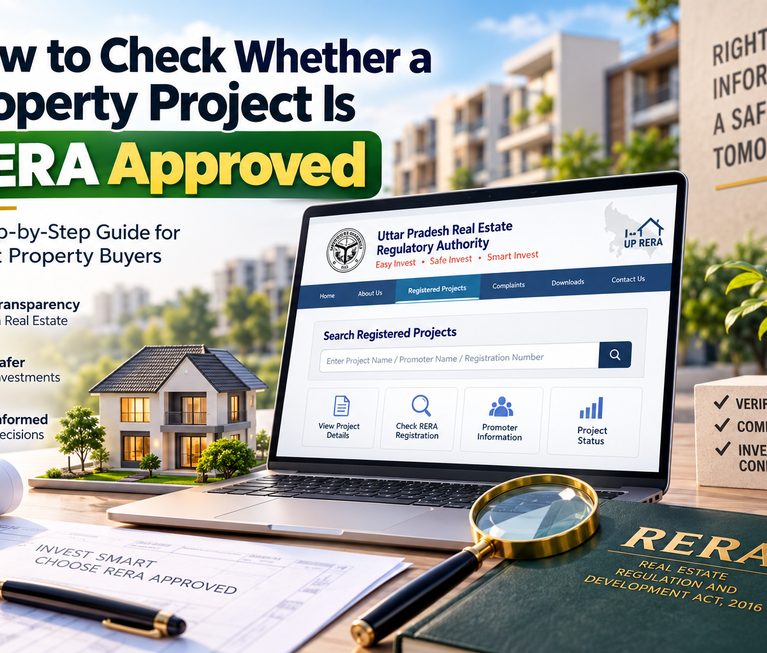
Buyers should not simply look at a RERA number printed in an advertisement. The registration number should be searched on the official RERA portal of the relevant state or Union Territory, and the resulting project information should be matched with the property actually being offered.
RERA and Buyers’ Money
Another important RERA provision relates to funds collected for a project. The Act requires the promoter to deposit 70% of amounts realised from allottees into a separate account in a scheduled bank to cover land and construction costs for that project. Withdrawals are linked to the percentage of project completion and are subject to specified certification and audit requirements.
This framework is intended to strengthen financial discipline in project development.
RERA and Real-Estate Agents
RERA does not deal only with developers. Real-estate agents facilitating sales in projects covered by the Act are also subject to registration requirements. Registered agents receive a registration number, and the Act prohibits them from facilitating sales in projects that are required to be registered but are not registered with the Authority.
The Act also requires registered agents to avoid specified unfair trade practices and to facilitate access to information and documents that an allottee is entitled to receive.
What Should You Check Before Buying?
RERA registration is an important verification step, but it should not be treated as a guarantee of investment returns or as a substitute for complete legal due diligence.
Before making a substantial payment, buyers should verify the RERA registration and project status, confirm the promoter and exact project/phase, review land-title and approval information, compare the sanctioned plan with the property being offered, understand the agreement for sale and payment schedule, inspect the site, and consider independent legal verification where appropriate.
A useful rule to remember is:
Verify the Project → Check the Documents → Visit the Site → Understand the Agreement → Then Invest.
What If a Buyer Has a Complaint?
RERA established regulatory authorities and an adjudicatory framework for the real-estate sector, along with an Appellate Tribunal for appeals from specified decisions, directions, or orders. Consumer protection and faster dispute resolution were among the stated objectives of the legislation.
The exact filing procedure, fees, forms, and online facilities can vary by state or Union Territory, so buyers should use the relevant official RERA portal.
Final Thoughts
RERA has made transparency, disclosure, accountability, and buyer protection central elements of India’s regulated real-estate market. For a property buyer, understanding RERA can make it easier to ask the right questions and verify important information before committing money.
A beautiful property and attractive price may catch your attention, but verification should come before investment.
Approved Properties
Building Trust. Creating Value.
At Approved Properties, our focus is to help buyers explore property opportunities with clear information, professional guidance, and a transparent buying process.