 Post by
 Buying a plot in Lucknow can give you the flexibility to build a home according to your needs or hold land as a long-term asset. But a good-looking location or attractive price is not enough. Before paying a booking amount, buyers should verify the land records, project registration, ownership, approvals, location and total cost.
Lucknow continues to see significant real-estate activity; for example, UP RERA reported in December 2025 that six newly approved projects in Lucknow represented ₹2,154.69 crore of estimated investment. That indicates substantial development activity, but every individual plot still requires its own due diligence.
1. Start With the Location
Location is one of the most important considerations when buying land. Instead of looking only at the distance from central Lucknow, consider how practical the location is for your intended use.
Check the approach road, existing and proposed connectivity, schools, hospitals, markets, employment areas, public transport and surrounding residential development. Also visit the location yourself rather than depending entirely on maps, advertisements or promotional videos.
A plot that is inexpensive today is not automatically a good investment. Future value depends on several factors, and appreciation is never guaranteed.
2. Verify the Ownership and Land Records
Before purchasing, establish who legally owns the land and whether the person or company selling it has the authority to do so.
Uttar Pradesh’s official Bhulekh system provides access to computerized land-record services, including Real Time Khatauni.
Check Uttar Pradesh land records on UP Bhulekh
Online records are useful for initial verification, but for a significant purchase, buyers should consider having the title chain, sale deeds, mutation/revenue records, encumbrances and seller’s authority independently checked by a qualified property lawyer.
3. Check Whether the Project Is Registered With UP RERA
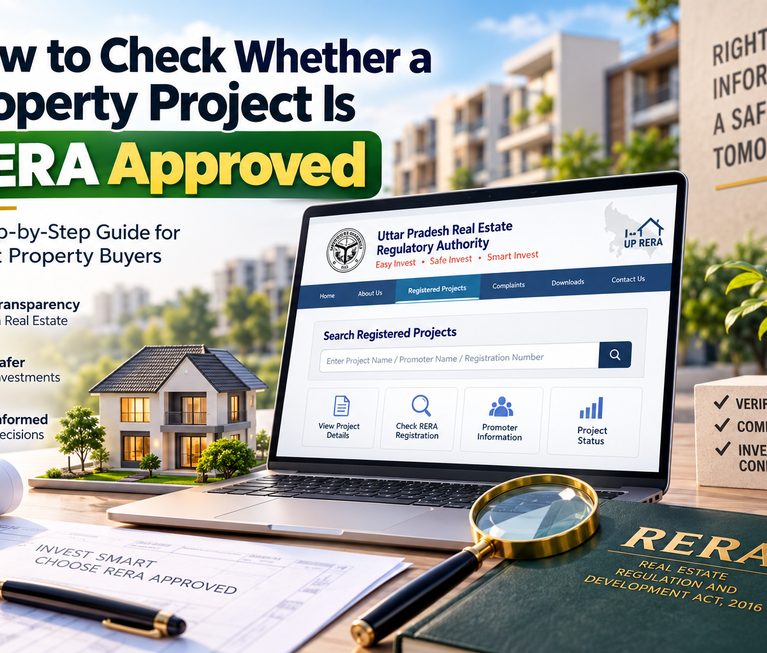
If you are buying a plot within a real-estate project that is required to be registered under RERA, verify the project on the official UP RERA portal.
UP RERA’s registered-project search allows buyers to search by district, promoter, registration number and project name.
Search registered projects on UP RERA
Do not simply accept a RERA number printed on a brochure. Search the number yourself and make sure the project name, promoter, location and relevant phase correspond to the plot being offered.
UP RERA notes that project registration is generally required before advertising, marketing, booking or selling a covered real-estate project, subject to statutory exemptions such as certain projects at or below the Act’s specified size/unit thresholds.
4. Verify the Layout and Relevant Approvals
A plotted development may look professionally planned on a brochure while its official approvals tell a different story.
Ask the seller for the sanctioned/approved layout and other applicable development approvals, then independently verify them with the relevant authority. Check that the plot number, dimensions, roads, open areas and other promised features correspond with the approved documentation.
Also establish which development authority or local body has jurisdiction over the particular land rather than assuming every property marketed as being in “Lucknow” falls under the same authority.
5. Match the Plot With the Actual Land
Documents and the physical site should tell the same story.
Confirm the plot’s number, dimensions, boundaries, access road and location against the relevant records and approved layout. For land-record verification, UP’s cadastral digitization system includes Lucknow district and its tehsils such as Lucknow, Bakshi Ka Talab, Malihabad, Mohanlalganj and Sarojini Nagar.
Where boundaries or measurements are unclear, professional surveying can be worthwhile before completing the purchase.
6. Check Road Access and Infrastructure
A plot may appear attractive but become difficult to use if access or infrastructure is inadequate.
During the site visit, check the width and physical condition of the approach road, internal roads, drainage, electricity availability, water arrangements, sewerage where applicable, street lighting and surrounding development.
Separate existing infrastructure from infrastructure that is merely proposed. If a seller says a new highway, metro connection, commercial hub or government project is coming nearby, independently verify that claim through an authoritative source.
7. Understand the Complete Cost
Do not plan your budget around the advertised plot price alone.
Your total acquisition cost may include the basic land price, applicable development or other project charges, stamp duty, registration expenses, legal verification costs, financing expenses and other applicable charges.
Ask for a written cost sheet before paying. It should make clear what is included and what could be charged separately.
8. Be Careful With “Guaranteed Returns”
Claims such as “prices will double,” “guaranteed appreciation,” “last plot available,” or “buy today for assured returns” should not be the basis for a property purchase.
Land values can rise or fall depending on infrastructure, demand, supply, legal status, economic conditions and the development of the surrounding area.
Evaluate the property based on verifiable facts rather than sales pressure.
9. Visit the Site More Than Once
A single scheduled visit may not reveal everything about a location.
When practical, visit during both daytime and evening and examine traffic, road conditions, waterlogging or drainage concerns, neighbourhood activity, nearby construction and accessibility.
Speak with people already living or operating businesses nearby where appropriate. Local observations can help you identify practical issues that may not appear in a sales presentation.
10. Get Independent Legal Verification
This is one area where trying to save a small amount can create much larger risks later.
Before paying a substantial amount or executing the sale deed, consider having an independent property lawyer examine the relevant title documents, ownership history, encumbrances, land-use status, applicable approvals, agreement terms and other documents relevant to that particular transaction.
A lawyer working for the developer or seller should not automatically be treated as your independent adviser.
Plot Buying Checklist for Lucknow
Before finalising your purchase, follow a simple sequence:
Choose Location → Visit the Plot → Verify Ownership → Check Land Records → Check RERA Where Applicable → Verify Layout & Approvals → Confirm Boundaries & Road Access → Review Total Cost → Get Legal Verification → Register the Property
Approved Properties
Building Trust. Creating Value.
At Approved Properties, we aim to help buyers explore plots and property opportunities in Lucknow with clear information, professional guidance and a transparent buying process.