 Post by
 How to Check Whether a Property Project Is RERA Approved
Buying a property is a major financial decision, so checking the project’s legal and regulatory status should be one of the first steps before paying a booking amount. In India, the Real Estate (Regulation and Development) Act, 2016—commonly known as RERA—was introduced to improve transparency and protect the interests of property buyers.
What Does RERA Registration Mean?
For projects that fall within RERA’s registration requirements, the promoter generally cannot advertise, market, book, sell, or offer plots, apartments, or buildings for sale without first registering the project with the relevant state Real Estate Regulatory Authority. The Act also provides certain exemptions, so the absence of a registration number does not automatically prove that a project is unlawful.
For buyers in Uttar Pradesh, project details should be checked directly through the official UP RERA website rather than relying only on advertisements, brochures, property agents, or screenshots provided by a seller.
How to Check a Project on UP RERA
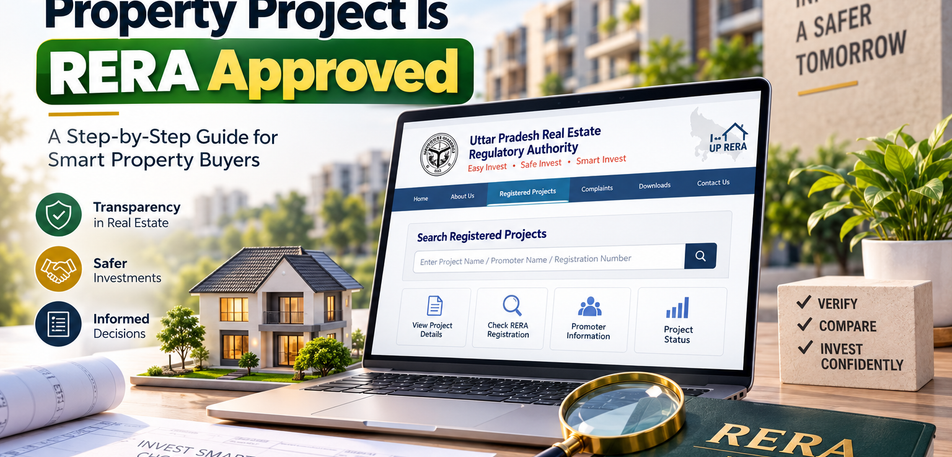
The process is straightforward. Visit the official UP RERA portal and open the Registered Projects search. The portal allows you to search using details such as the district, promoter, registration number, or project name.
Once you locate the project, carefully match the information displayed on the RERA portal with the property being offered to you. Pay particular attention to the project name, promoter/developer, location, registration details, project status, land and plan information, and documents available on the portal.
If the developer has given you a UP RERA registration number, you can also use the official Verify RERA Registration facility and enter that registration number directly.
Search Registered Projects on UP RERA
Don’t Check Only the RERA Number
Finding a registration number is an important step, but buyers should go further. Confirm that the number actually belongs to the same project, promoter, location, and phase you are considering.
This is particularly important for large developments because the RERA Act treats each phase of a project as a standalone real-estate project for registration purposes. A registration for one phase should therefore not simply be assumed to cover another phase.
UP RERA also maintains separate categories for projects such as Completed Projects, De-registered Projects, Projects in Abeyance, Withdrawn Registrations, and certain NCLT projects. Checking the current project status can therefore provide information beyond merely seeing a RERA number.
Check the Promoter and Project Documents
RERA registration involves detailed information about the promoter and project. The UP RERA registration system includes sections covering promoter details, basic project information, plans, development works, land details, bank details, uploaded documents, targets and contact details.
Before purchasing, compare the information available on the official portal with what the developer or seller has promised. If important details do not match, seek clarification and, where appropriate, independent legal advice before making a payment.
Be Careful With Payment Details
UP RERA specifically advises allottees to make payments to the promoter through the project’s designated Collection Account and provides facilities for viewing those account details.
Never rely solely on a salesperson’s verbal assurance or an account number sent through an informal message. Verify the relevant project and payment information independently.
What If You Cannot Find the Project?
If a project does not appear in the registered-project database, do not immediately conclude either that it is fraudulent or that everything is fine. First confirm that you have searched using the correct project name, promoter, district, and registration number.
Some projects can be exempt from registration under Section 3(2) of the RERA Act—for example, subject to the statutory conditions, projects where the proposed land area does not exceed 500 square metres or the number of apartments does not exceed eight, as well as certain completed, renovation, repair, or redevelopment projects. State-specific rules and circumstances can also matter.
UP RERA also provides a mechanism for information relating to unregistered projects and for checking the status of such matters.
A Simple Rule Before You Buy
Search → Verify → Match Documents → Visit the Site → Check Payment Details → Then Proceed.
A property may look attractive and the location may appear promising, but verification should come before investment. Checking the official RERA record can help you make a more informed property decision and identify inconsistencies before committing significant money.
Approved Properties
Building Trust. Creating Value.
At Approved Properties, our goal is to help buyers discover suitable property opportunities with clear information and professional guidance throughout their property-buying journey.
Buying property is not just about owning land or a home—it is about choosing an asset that can support your lifestyle, financial goals, and future plans. Whether you are purchasing your first residential plot, planning your dream home, or investing for long-term growth, making the right decision requires careful consideration.
At Approved Properties, we believe that a smart property decision begins with the right information, the right location, and reliable guidance.
1. Location Should Be Your First Priority
One of the most important factors when buying property is location. A good location can provide better connectivity, convenience, quality of life, and stronger potential for future development.
Before choosing a property, consider its proximity to:
- Schools and educational institutions
- Hospitals and healthcare facilities
- Markets and shopping areas
- Major roads and highways
- Public transportation
- Employment and commercial hubs
- Upcoming infrastructure developments
A developing location with improving infrastructure may also offer attractive long-term investment potential.
2. Check Property and Project Approvals
Never make a property decision based only on attractive pricing or promotional offers.
Before purchasing, buyers should carefully verify applicable approvals, ownership documents, project details, and legal paperwork. Depending on the property and jurisdiction, different approvals or registrations may apply.
Proper verification can help reduce uncertainty and give you greater confidence in your purchase.
3. Understand Your Purpose
Before searching for property, ask yourself one simple question:
Why am I buying this property?
Your requirements may be completely different depending on whether you are buying to build your own home, hold the property as a long-term investment, or meet another personal or business objective.
Defining your purpose makes it easier to shortlist suitable properties and avoid unnecessary choices.
4. Look Beyond the Current Price
A low price does not automatically make a property a good investment.
Consider the overall value of the property, including its location, accessibility, surrounding development, infrastructure, neighborhood, project quality, and potential demand.
A well-selected property should make sense not only for your budget today but also for your plans for tomorrow.
5. Visit the Property Before Making a Decision
Photos, videos, and brochures can help you shortlist properties, but a site visit gives you a much clearer understanding of the actual location.
During your visit, check the surrounding roads, neighborhood, accessibility, nearby facilities, development status, and overall environment.
At Approved Properties, we help customers explore suitable opportunities and arrange site visits so they can evaluate properties more confidently.
Why Choose Approved Properties?
Finding the right property can become complicated when there are too many options and too little reliable information.
Approved Properties aims to simplify the process through transparent communication, customer-focused assistance, and carefully selected property opportunities.
From understanding your requirements and exploring available projects to scheduling site visits and supporting your decision-making process, our team is committed to making your property journey smoother.
Build Your Future with the Right Property
A property is more than a purchase. It can become your future home, a valuable family asset, or an important part of your long-term investment strategy.
Take the time to research, compare, verify, and choose carefully.
With Approved Properties, discover opportunities designed around trust, value, location, and future potential.
Start Your Property Journey Today
Looking for the right residential plot or investment opportunity?
Connect with Approved Properties to explore available projects and schedule a site visit.
Approved Properties — Your Trusted Property Partner.