 Post by
 For many government employees, buying a property is one of the biggest financial decisions of their working life. A stable salary and predictable career path can make long-term planning easier, but a property purchase still requires careful budgeting, legal verification, loan comparison, and documentation.
Whether you are planning to buy a residential plot, flat, villa, or house, this guide explains the key steps to consider before making a decision.
1. Start With Your Budget
Before searching for properties, determine how much you can comfortably afford—not simply the maximum loan amount a lender may offer.
Consider your monthly income, existing EMIs, household expenses, emergency savings, retirement goals, children’s education, and other financial commitments. Also budget for costs beyond the advertised property price, which can include stamp duty, registration charges, taxes where applicable, loan-related charges, maintenance and other transaction expenses.
Keeping a financial buffer can help prevent a property purchase from putting unnecessary pressure on your monthly salary.
2. Decide Why You Are Buying
Your property requirements will depend heavily on your objective.
If you are purchasing for your family, factors such as schools, hospitals, markets, safety, commuting time and everyday connectivity may matter most. If the purchase is primarily an investment, you may focus more on infrastructure development, demand, accessibility, legal clarity and the area’s long-term development prospects.
For government employees who may be transferred during their careers, accessibility and the practicality of managing the property from another city can also be worth considering.
3. Choose the Right Type of Property
There is no single property type that suits every buyer. A residential plot provides flexibility to construct later according to your requirements, while a ready-to-move house or flat can be more suitable when immediate possession is important.
Compare each option based on your budget, intended use, maintenance requirements, possession timeline, location and legal documentation rather than relying only on expected future appreciation.
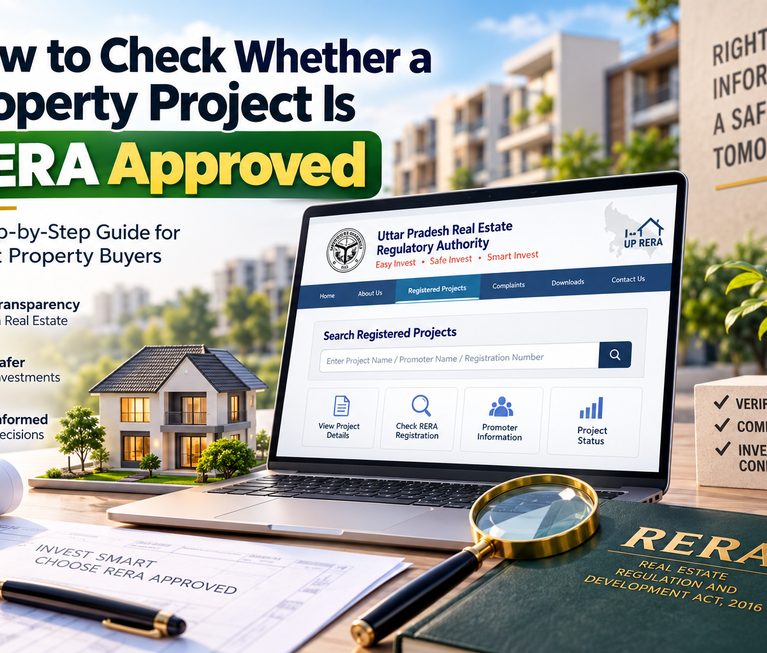
4. Check RERA Registration Where Applicable
For projects covered by the Real Estate (Regulation and Development) Act, 2016, checking RERA information is an important part of due diligence. The Act generally prohibits a promoter from advertising, marketing, booking, selling or offering a property in a project that requires registration before registering it with the relevant Real Estate Regulatory Authority. The law also provides specified exemptions.
Always search for the project through the official RERA portal of the relevant state or Union Territory and match the registration details with the exact project and phase you are considering.
For properties in Uttar Pradesh, buyers can use the official UP RERA portal.
5. Verify the Property Documents
A good location and attractive price should never replace legal verification.
Before making a substantial payment, check relevant ownership/title documents, land records, applicable approvals, sanctioned layout or building plan, encumbrance information, seller/promoter authority, RERA information where applicable, agreement terms and registration-related documents.
The exact documents required depend on whether you are purchasing a plot, apartment, resale property, under-construction property or another type of real estate. Independent verification by a qualified property lawyer can be valuable before signing or paying a significant amount.
6. Visit the Property Personally
Photos, videos and brochures are useful for initial research, but they should not replace a physical site visit.
During your visit, examine the approach road, surrounding development, drainage and utilities, nearby residential activity, public transport, hospitals, schools and markets. For plotted developments, compare the physical plot and layout with the documents being shown to you.
If possible, visit the location at different times rather than judging it from a single scheduled sales visit.
7. Compare Home and Property Loans Carefully
Government employees may receive loan offers from multiple banks and housing-finance institutions. Do not choose a loan only because the advertised interest rate appears low.
Compare the interest-rate structure, loan tenure, processing charges, prepayment conditions, total repayment amount and other applicable terms. Eligibility and loan conditions differ by lender and borrower profile.
A longer tenure can reduce the monthly EMI but may substantially increase the total interest paid over the life of the loan.
8. Understand Government-Employee Housing Benefits
Depending on your employment category, department and applicable service rules, you may have access to housing-related benefits or schemes.
For example, eligible Central Government employees can refer to the Ministry of Housing and Urban Affairs’ official information on House Building Advance (HBA). Eligibility, permitted purposes, limits, interest rates and conditions are governed by applicable rules and can change, so employees should verify the current provisions before planning a purchase. Ministry of Housing and Urban Affairs – House Building Advance
State-government employees should similarly check the latest rules issued by their respective government or department rather than assuming that Central Government provisions apply to them.
9. Think About Your Retirement Timeline
Property planning can be particularly important for employees approaching retirement.
Consider how many earning years remain, how long the proposed loan would continue, expected retirement income, other retirement goals and whether a large EMI would remain manageable after leaving service.
A property can be an important long-term asset, but it should form part of a broader financial plan rather than consume all available savings.
10. Don’t Buy Only Because Someone Says Prices Will Rise
Statements such as “prices will double soon,” “last few plots left,” or “guaranteed returns” should not substitute for research.
Property values are influenced by many factors, including demand, infrastructure, connectivity, supply, economic conditions and local development. Future appreciation cannot be guaranteed simply because a project is new or located near a proposed development.
Ask for evidence behind important claims and independently verify infrastructure or government-project announcements through official sources.
A Simple Property-Buying Checklist
Before finalising a property, remember:
Set Your Budget → Choose the Location → Verify the Project → Check Documents → Visit the Site → Compare Financing → Understand the Agreement → Register the Property
The goal should not simply be to buy a property, but to make a purchase that fits your family’s requirements, finances and long-term plans.
Why Government Employees Should Prioritize Verification
A regular salary may make financing more predictable, but it does not eliminate property-related risks. Legal clarity, transparent documentation, realistic budgeting and careful verification remain essential for every buyer.
Taking a little more time before paying can be far easier than dealing with documentation, possession or financial problems later.
Approved Properties
Building Trust. Creating Value.
At Approved Properties, we aim to help government employees, salaried professionals and families explore suitable property opportunities with clear information and professional guidance throughout their property-buying journey.